Do the HOMEWORK
A framework for smarter business growth
No one likes homework. The word alone can trigger memories of late nights, pressure, and something you would rather avoid. But there is a truth that follows you from school into business: if you do not do the homework, you cannot expect the result. You might still get lucky, but you will have far less control over the outcome.
In business, homework does not mean writing a 20-page plan or producing documents for the sake of it. It means using the small windows of time you have, when you have them, to invest in the future of your business. Those windows might appear early, when you are building momentum, or later, when you are busy but need to reset and refocus. The owners who scale sustainably are the ones who treat those windows as valuable and use them deliberately.
The concept of “HOMEWORK” is a simple framework I use to help business owners decide what to focus on when they have the opportunity to work on the business rather than in it. It is memorable, practical, and flexible. You do not have to follow it in a perfect order, but each part matters. Done consistently, it creates better decisions, better structure, and more predictable progress.
H – Hours: Invest your time intentionally
Everything starts with time.
If you find yourself with spare hours in a week, the question is whether you are investing them or simply filling them. There are seasons where you are fully consumed by operations, but there are also windows where you can step back and improve the foundations of your business.
Those windows get smaller as you grow. That is why when you do have the hours, it is worth using them wisely. Homework is not about today’s workload, it is about strengthening tomorrow’s position.
O – Opportunity: Look beyond the obvious
Most business owners focus narrowly on the opportunity in front of them – the job, the sale, the contract. But the real value is often found just outside the obvious.
What systems need tightening so this opportunity runs smoother next time? What KPI should be tracked? What process failed previously that needs refinement?
Even failure is opportunity if you treat it as homework. Instead of moving on quickly, ask what needs to change so it does not happen again. Opportunity is not only about growth. It is about improvement.
M – Motivation: Maintain the engine
Think of yourself as the engine of your business. Motivation is the oil.
Without oil, an engine grinds, overheats, and eventually breaks down. In the same way, without motivation, friction increases and performance drops.
Motivation is not hype. It is the drive to learn, to fix problems, and to improve. Like an engine, it needs maintenance. It needs topping up. That might mean seeking new ideas, surrounding yourself with sharper people, or reconnecting with your purpose.
Let your motivation to succeed and to learn fuel the engine.
E – Enterprise: Align the vision
Enterprise refers to your business – the structure and organisation you are building. But it also refers to being enterprising.
Are you thinking entrepreneurially? Are you looking for best-in-class examples outside your own industry? Are you communicating your vision clearly to your team?
A common trap in small business is that the owner carries the strategy alone. The team has no idea what the bigger picture looks like. Enterprise requires communication. If people do not know the direction, they cannot move toward it.
W – Willingness: Do the uncomfortable work
Motivation is one thing. Willingness is another.
You may want growth, but are you willing to do the uncomfortable tasks that make growth possible? For many owners, that means selling, holding standards, having difficult conversations, or stepping into areas that are outside their comfort zone.
Being willing is one part. Being able is another. If you lack skill in an area, you can learn it or bring someone in. But nothing changes without willingness.
Growth rarely sits inside your comfort zone.
O – Organise and organisation: Build structure for scale
Without organisation, growth becomes chaotic.
Being organised helps you respond to curve balls with clarity rather than panic. It also keeps you aligned with your longer-term vision.
Your future organisation, the structure you ultimately want, is your beacon. Your organising today is the map that gets you there. This is where role clarity, systems, and even your organisational chart matter. Break big goals into manageable pieces and move step by step.
Long journeys are completed in stages, not leaps.
R – Reward and risk: Be clear on the trade-off
We enter business for reward. That reward may be financial, lifestyle-based, community-driven, or personal achievement.
Once you define the reward clearly, you can assess what level of risk you are prepared to take to achieve it. Putting reward first keeps your thinking intentional and positive. Risk becomes something you manage, not something that surprises you.
The greater the reward, the more deliberate you must be about the risk.
K – Knowledge: Keep learning beyond your circle
Knowledge underpins everything.
The more knowledge you accumulate, the more options you create. Knowledge builds confidence and improves decision-making. But it is not always found in your immediate industry.
If you are in trades, you might learn more about customer experience from hospitality. If you are in professional services, you might learn operational discipline from manufacturing.
Seek knowledge deliberately. Fill the gaps in your understanding. Surround yourself with people who are willing to share what they know.
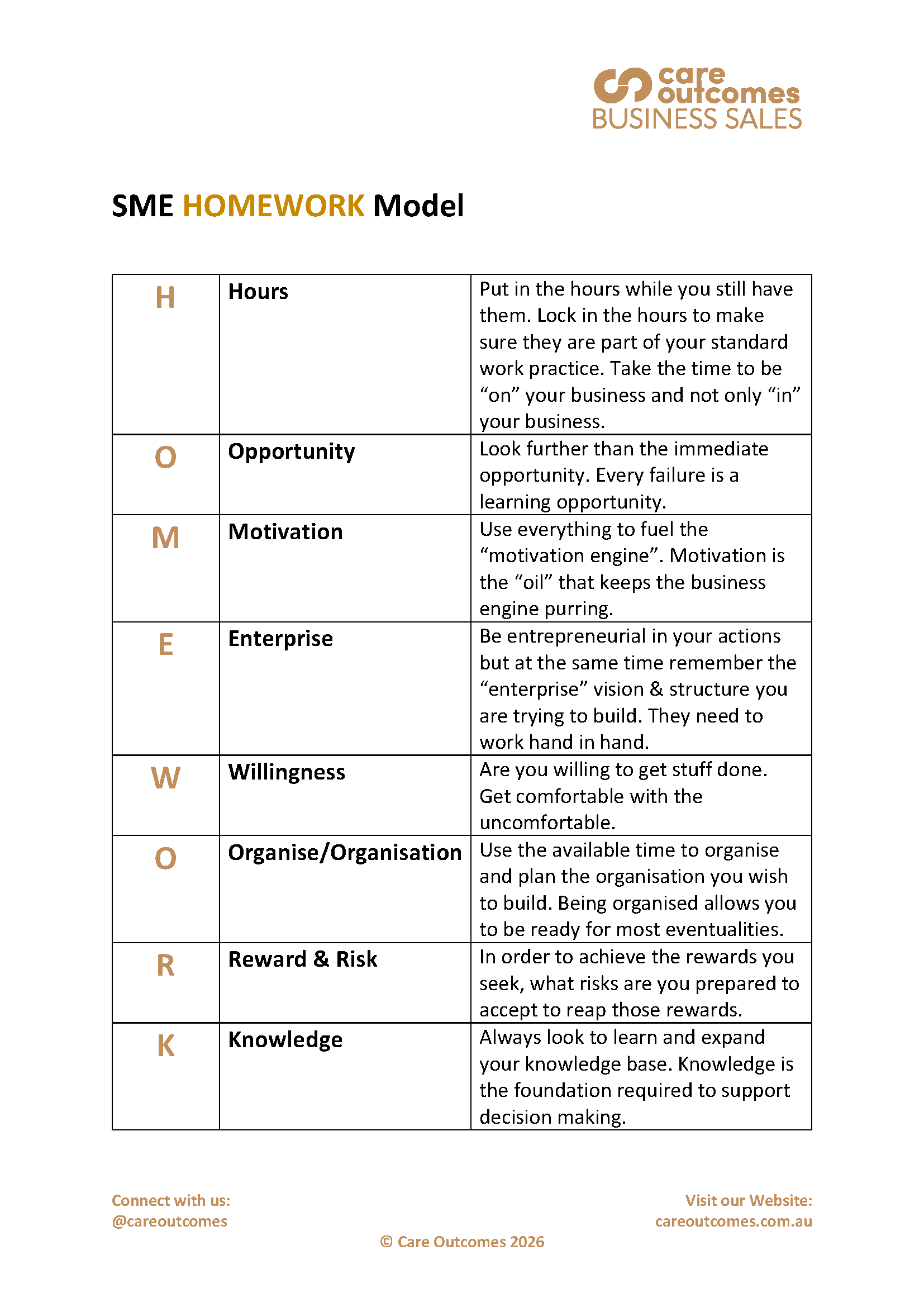
Overview of the HOMEWORK concept
Success comes from doing the homework
This framework is not a replacement for a business plan. It is not meant to be complicated or time-consuming. It is simply a structured way to use your time wisely when you have it.
Whether you are starting out or preparing for your next stage of growth, the principle is the same. Small, deliberate investments now create stronger outcomes later.
Doing the homework may not feel urgent today. But in one quarter, two quarters, or two years, it can be worth gold.
Because in business, as in life, the results rarely exceed the preparation.